A new category of AI. Optimized Decision-making AI.

Heuristka · ODAI · Optimized Decision-making AI

New technology ≠ a new way of war. Tank ≠ Blitzkrieg. (Technology + new organizations + new tactics) × iteration = radical change potential.

Request a briefing See the Helix
Marines wading ashore from a landing craft at first light

Technology · Organization · Doctrine

AI has not changed warfare. Yet.

Technology
Everyone is using it

AI. The kill chain, compressed from days to seconds.

Organization
Nobody has built it

The staff, task-organized around the problem. Its architecture unchanged since Napoleon.

Doctrine
It comes last

Written from what the new organization proves in the field, through iteration.

The tank existed for more than twenty years before Blitzkrieg. Then the Germans built a new kind of organization: fast tanks and aircraft, linked by radio, all fighting in concert. The Panzer division. After many iterations, Blitzkrieg became its doctrine.

AI is the 21st-century tank. It has yet to spawn organizational or tactical change. Yet it holds the potential to radically change the one thing that has not changed since Napoleon: the architecture of the military staff.

Staffs tailored to each problem, task-organized and augmented by ODAI with whatever expertise the task demands, will find new ways of using force. Through iteration, those ways become the new doctrine.

ODAI will be the foundation for whatever the Blitzkrieg of the 21st century becomes.

Three soldiers in silhouette at dusk, conferring

The organization

Staffs form around the problem, not the chart.

The Napoleonic staff is fixed sections, built so a general could command more than he could see. For twenty years the operating forces have tried to break out with task forces, fusion centers and cross-functional teams, and each hit the same wall: the technology did not exist. Now it does.

This is for the combatant commands and the forces under them. The services' work of manning, training and equipping goes on as before.

  1. Form

    A cadre from the advanced schools (SAMS, SAASS, SAW, MAWS) and the experts the problem calls for.

  2. Solve

    They work the problem with ODAI in every direction at once, each function refining its part.

  3. Move on

    The cell dissolves. Its judgment stays in the audit trail.

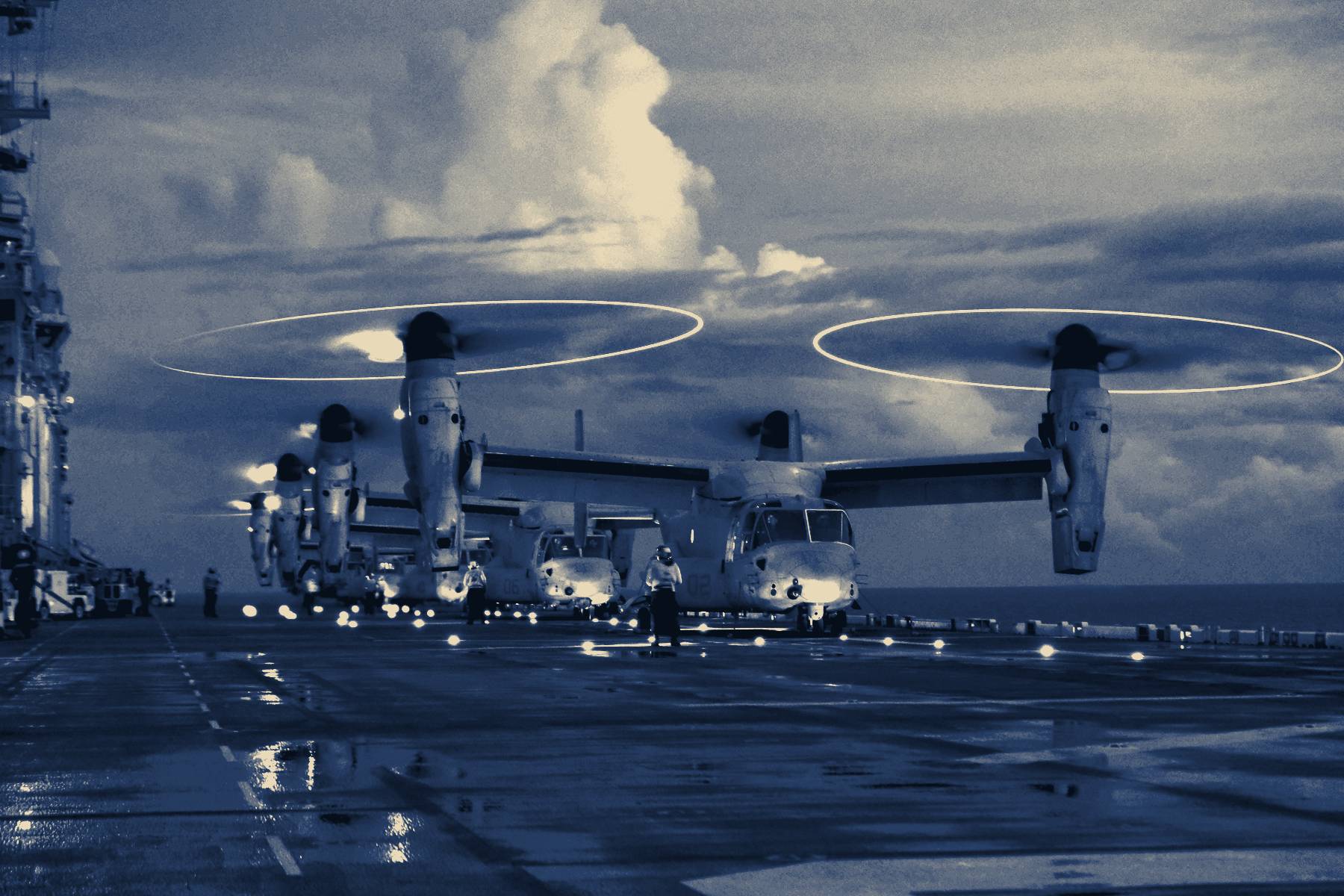
A flight-deck director signalling a helicopter with light wands at night

The staff multiplier

As many agents as the problem needs.

An agent is AI given a job, not just a question. Heuristka builds ODAI's agents to order, on any subject, to serve any section of the staff or a cell formed around a task.

How an agent works

  1. Tasked

    A person on the staff sets the job: tanker traffic through a strait, an adversary minister's record, a fuel plan.

  2. Works

    The agent gathers what bears on the job, works through it step by step and checks its own output, at machine speed.

  3. Reports

    It hands back its findings, sources attached, to the person who set the job. That person decides.

  4. Iterates

    Person and agent go back and forth until the work is right. Only then does it enter the planning cycle, to mix with every other section's.

Our adversaries operate in cells. For the first time since Waterloo, so can a staff.

Tame problems and wicked ones

Tame problems to the machine. Wicked to judgment.

Planners work in a volatile, uncertain, complex and ambiguous world. Most staff work is tame. The decisions that lose wars are wicked.

An F-22 Raptor banking hard, afterburners lit
Tame
  • Can be stated before it is solved
  • Right or wrong, and testable
  • Logistics, timelines, targeting data
  • Even a stealth fighter, or a moon landing, has a mathematical answer

To the agents, at machine speed.

Two officials walking through an honor cordon at the Pentagon
Wicked
  • Not understood until a solution is tried
  • Better or worse, never final
  • Whether to act, what it buys, what it costs elsewhere
  • Politics, economies, finance, strategy: everything that turns on people

To the people, with ODAI testing the frame.

The kill chain is a tame-problem machine, and a superb one. The failures in the record below were wicked problems mistaken for tame.

An F-16 lifting off into a low sun

The doctrine

Boyd never said the fastest wins.

John Boyd's OODA loop had a center of gravity, and it was orientation, not speed: understanding the war you are in. The loop became a race, and the race left orientation behind. Unguided speed gets you nowhere, faster.

Speed is the multiplier. Judgment is what it multiplies.

The kill chain answers two questions faster than any staff in history: can we hit this, and may we. It was never built to answer the third: should we, and what will it buy? Compress days into seconds and that question disappears.

Orientation produces the one output no one in a kill chain is paid to want: a reason to adapt.

A pilot in an open cockpit against the setting sun

First principle

War is a human activity. Machines serve it.

Every judgment ODAI produces goes to a person, who interprets it and iterates: a continuous human–machine interface, in that order. ODAI is human-guided AI: the machine serves the human.

The machine prompts: the bias in the frame, the dataset no one opened, the case from any past war that resembles this one, with what is relevant in it marked and what is not. The analyst decides what it means.

Options with their confidence stated, never verdicts. Perfected, not perfect. ODAI augments the staff; it never replaces it.

The record · Humans and machines

Each fails where the other sees.

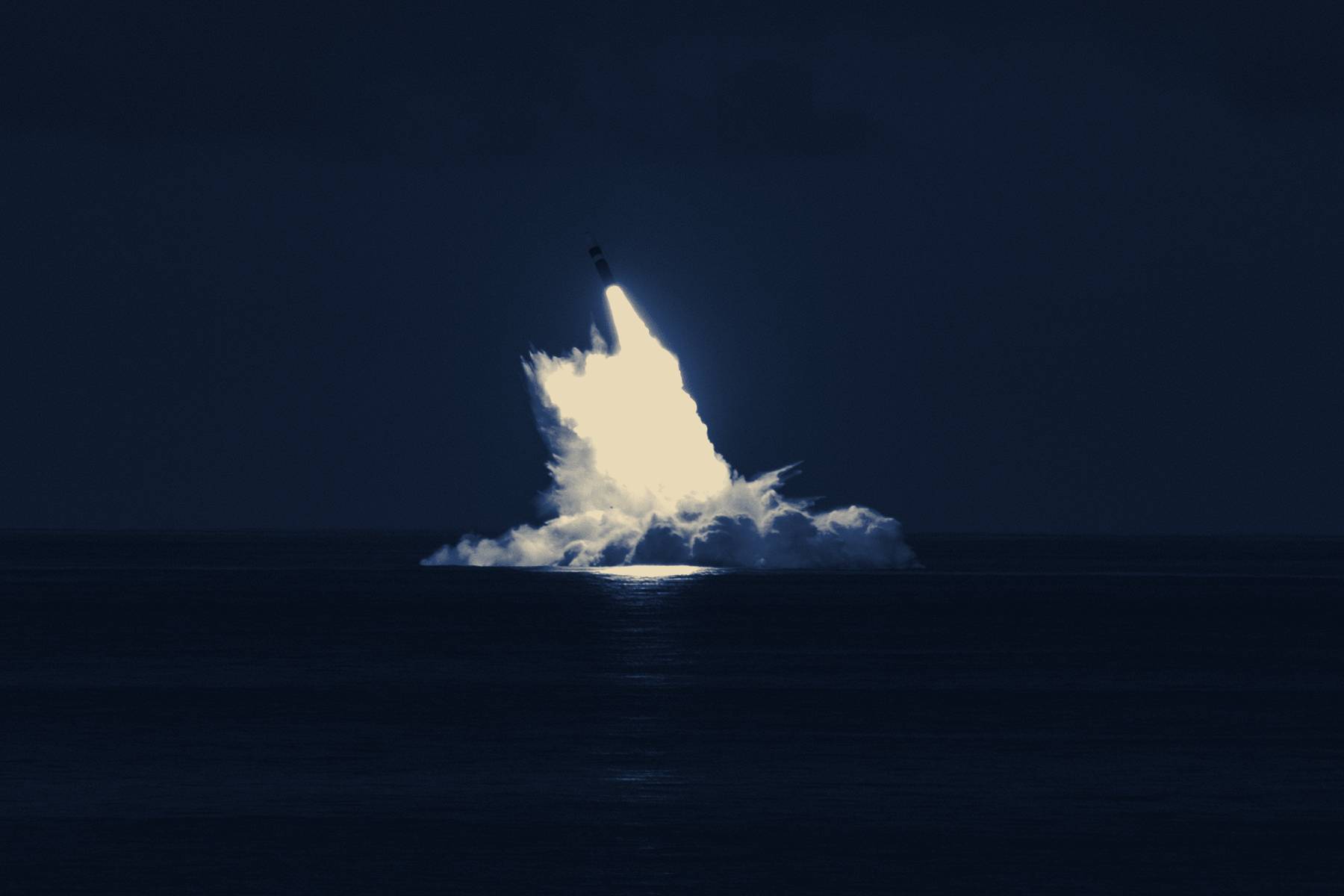
A missile breaking the surface of the sea in a column of fire

Machine wrong · human right

1983

Soviet satellites reported five American missiles in flight. Stanislav Petrov judged a real attack would not look like this. Sunlight on cloud.

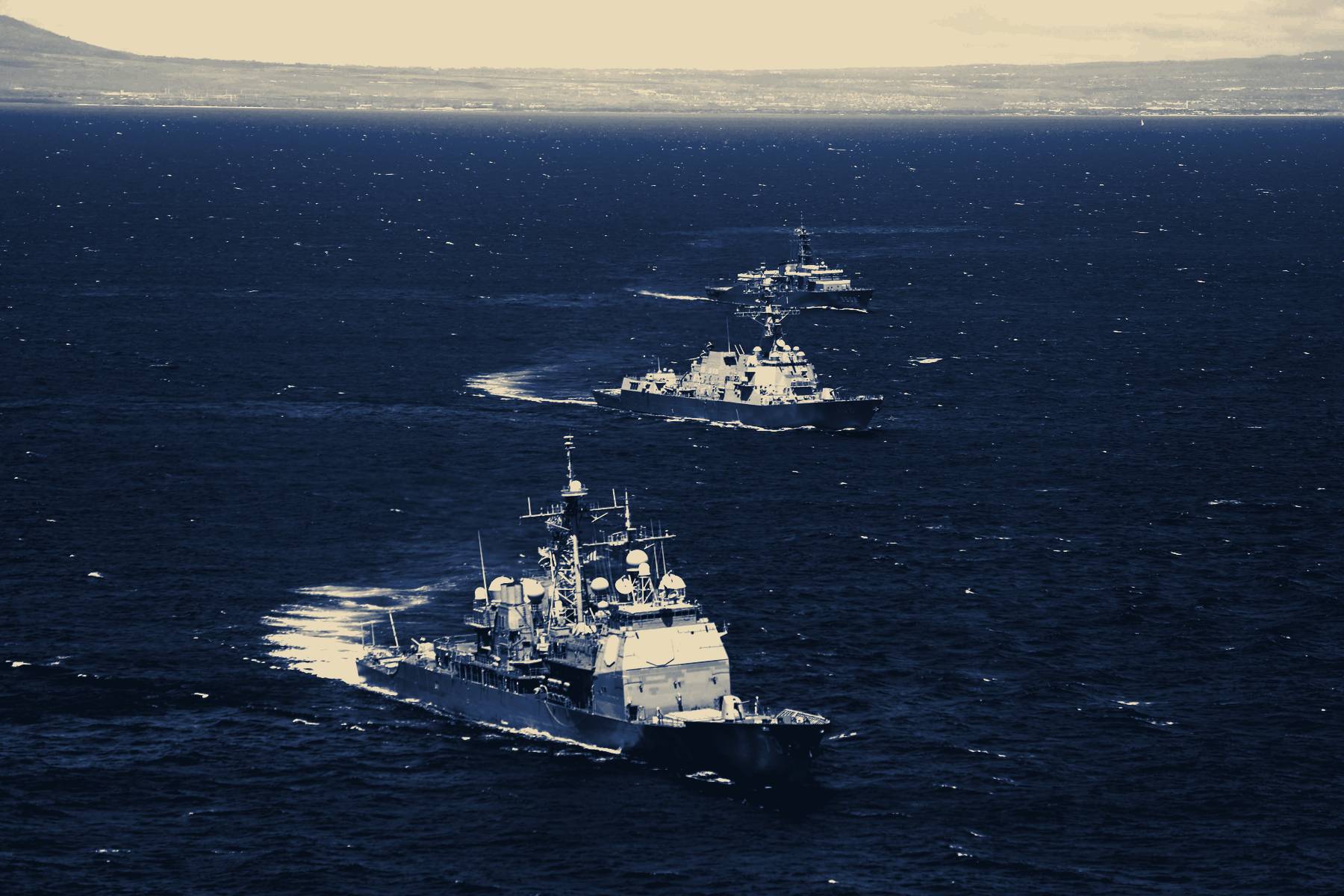
A guided-missile cruiser underway, two destroyers astern

Machine right · human wrong

1988

USS Vincennes. Aegis showed an aircraft climbing on a civilian airway. A crew under fire saw a descending fighter and shot down Iran Air 655.

Lightning striking behind two aircraft on a wet flightline

Human and machine: both wrong

2003

Patriot classified a British Tornado and a Navy F/A-18 as missiles. Operators with seconds to act trusted it. Both were shot down by their own side.

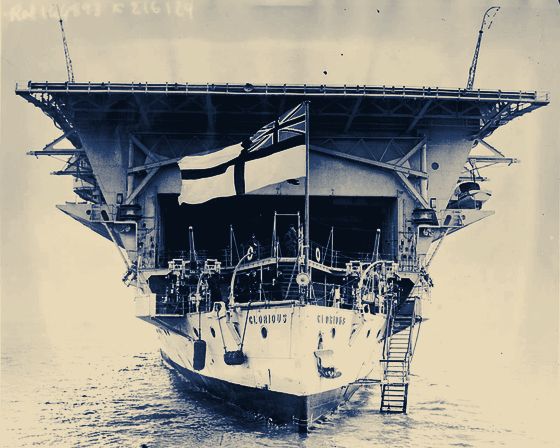
HMS Glorious at anchor, seen from astern
HMS GloriousImperial War Museums
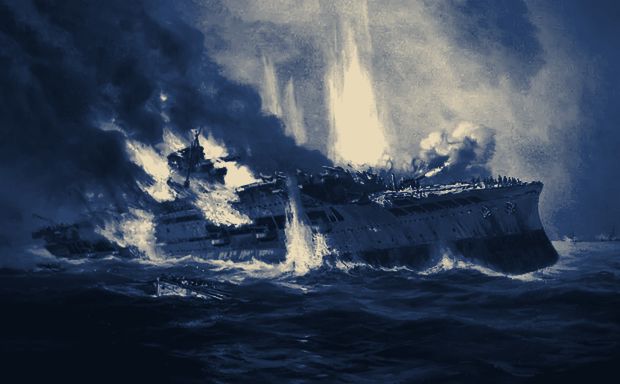
A German wartime painting of Glorious sinking under fire
The sinking, as Germany painted itBundesarchiv

Analysis right · organization wrong

1940

Bletchley Park's traffic analysis indicated the German heavy ships were at sea. The analyst was Harry Hinsley, aged 21, and the Admiralty would not trust a source it had never seen proved. On 8 June, HMS Glorious met Scharnhorst and Gneisenau with no warning. More than 1,500 men were lost.

The warning existed. It failed not on its evidence but on its standing: a new source, an untested method.

Information → Process → Judgment

A new category of AI

Nothing like it has been built before. The AI in the field works on information, or on process. ODAI works on the judgment that uses them.

Small AI. Small in scope, deep in its domain. Small describes the focus, not the size of the model.

Information

Generative AI creates content. Predictive AI forecasts. Analytical AI classifies data. All operate on information.

Process

The AI entering military planning makes the workflow faster and measures itself in time saved: the kill chain's logic, applied to the staff.

Judgment

ODAI operates on judgment. It tests the frame, the assumptions, the biases and the link from action to effect, with the expert as the filter. It measures itself by effect.

Built to protect human judgment from itself.

Not a prediction machine. Not a content generator. Not a targeting system.

Boyd's loop

The loop has a center.

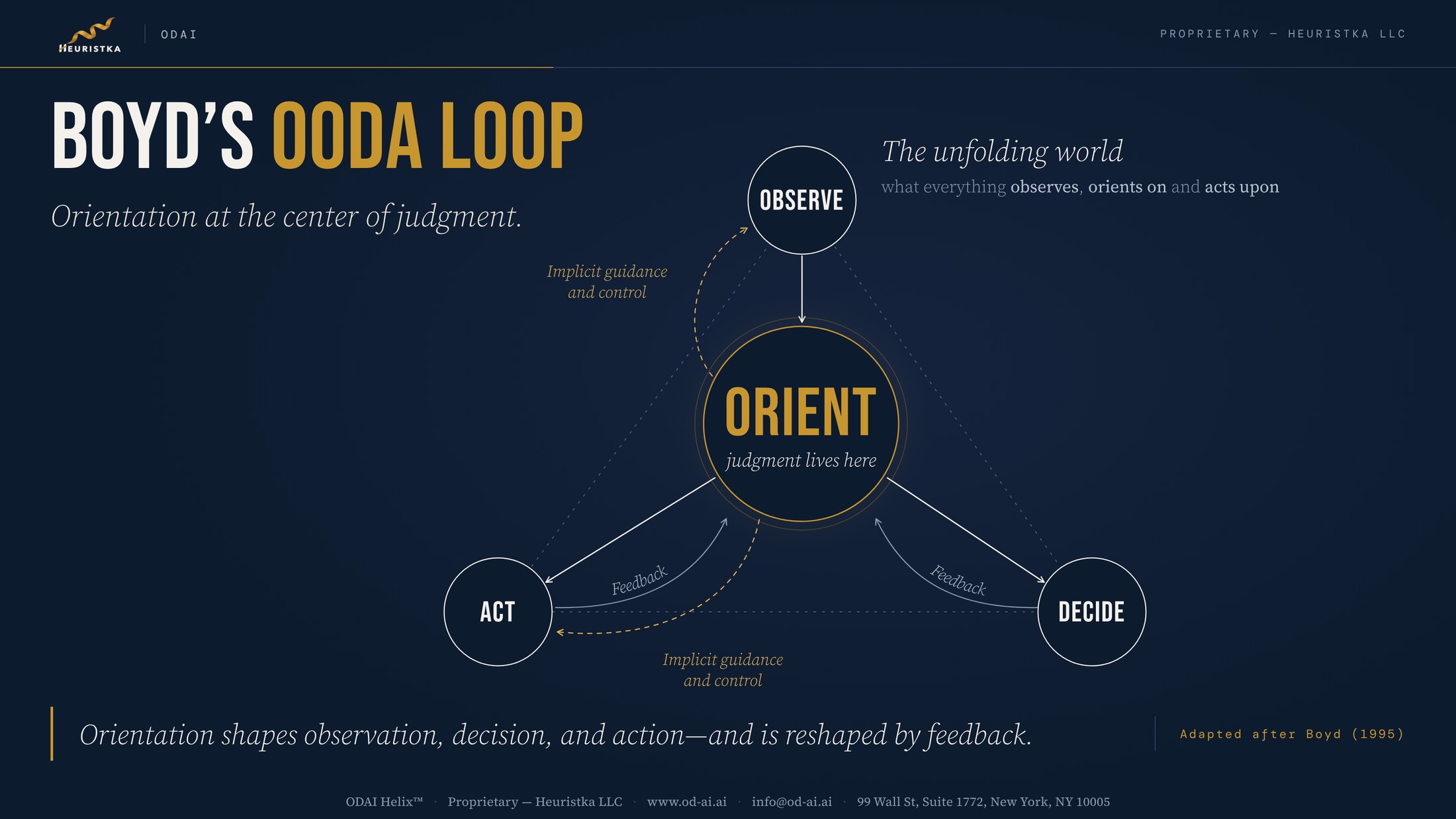
Boyd put orientation in the middle, shaping what is observed, decided and done. Draw it as a circle and the center is lost.

From OODA loop to ODAI Helix

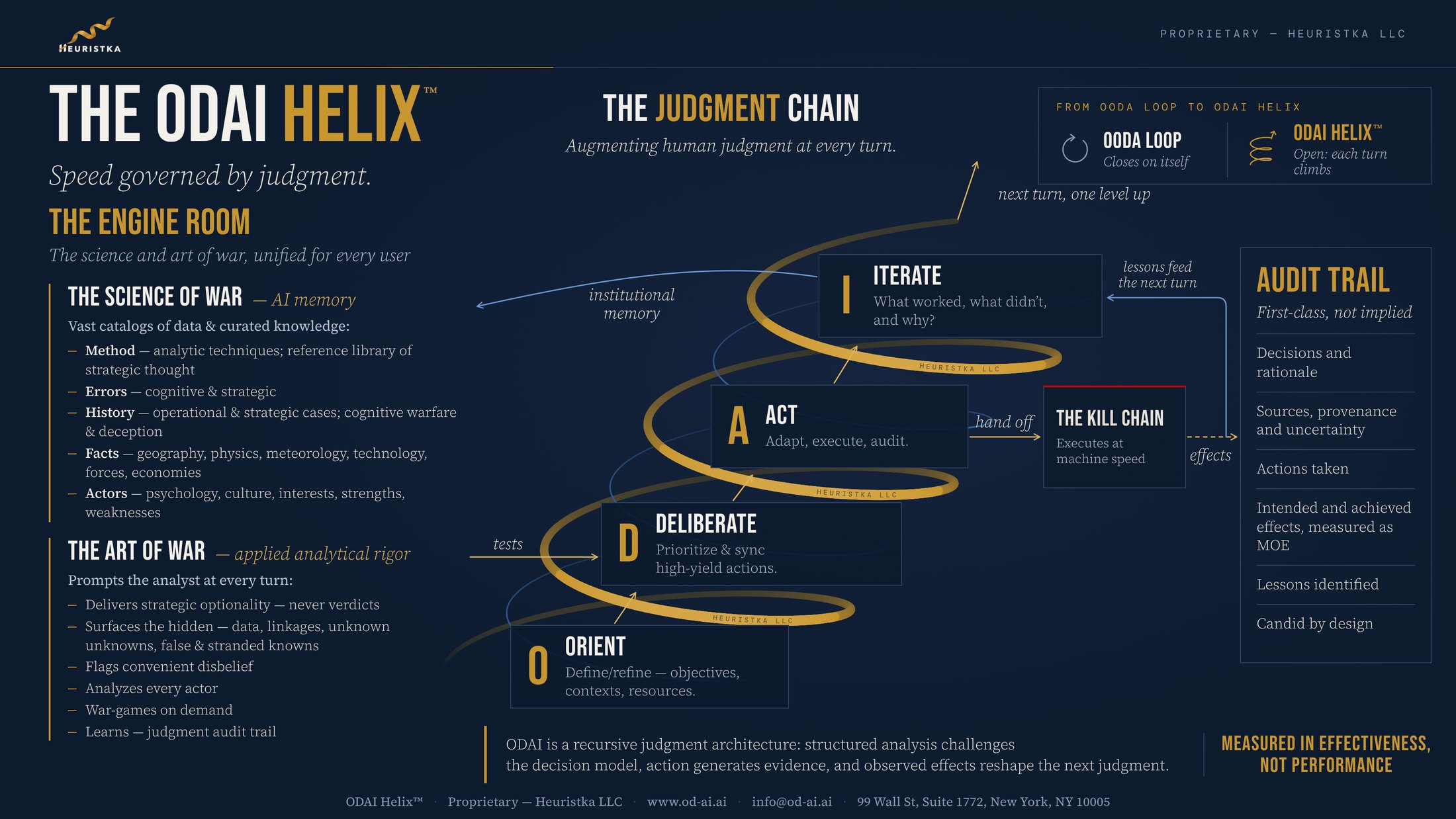
A loop closes. A helix climbs.

Drawn as a loop: observe, orient, decide, act. Each cycle returns to where it began.

The ODAI Helix™

Speed governed by judgment.

Each turn draws on the audit trail of decisions, actions and measured effects, so the next starts one level up.

At every phase, Boyd's triangle keeps turning. Orientation is not one step in the cycle; it runs through all of them.

OrientDeliberateActIterate
Boyd's OODA loop drawn as a triangle: Observe, Decide and Act at the corners, Orient at the center, with implicit guidance and control and feedback arrows
Boyd's loop, as Boyd drew it. Tap to enlarge. Adapted after Boyd (1995)
The ODAI Helix: Orient, Deliberate, Act, Iterate, climbing through the engine room to the kill-chain hand-off and the audit trail
The ODAI Helix. Tap to enlarge. Measured in effectiveness, not performance

The engine room

The science and art of war, unified.

ODAI remembers more than any staff can and thinks across all of it. Any data source plugs in.

Sailors at consoles in a darkened compartment

The science of warAI memory

Vast catalogs of data and curated knowledge. Among them:

MethodMore than a thousand analytic techniques; a reference library of strategic thought
ErrorsNearly a hundred cognitive and strategic biases, and growing
HistoryOperational and strategic cases; cognitive warfare, deception and propaganda
FactsGeography, physics, meteorology, technology, forces, economies, finance, supply chains
ActorsPsychology, culture, interests, strengths, weaknesses; the information they live in

Built from vetted sources and curated by a scholar of strategy and intelligence and an operational commander, not scraped from the open web. When NewsGuard tested ten leading AI chatbots in 2025, they repeated planted false narratives a third of the time.

The art of warapplied analytical rigor

Prompts the analyst at every turn.

  • Delivers strategic optionality, never verdicts
  • Surfaces the hidden: data, linkages, unknown unknowns, false and stranded knowns
  • Flags convenient disbelief
  • Analyzes every actor
  • War-games on demand
  • Learns, through a judgment audit trail

What it thinks with

Known knownsKnown unknownsUnknown unknownsFalse knownsStranded knowns

A false known looks exactly like a true one until it is checked.

Nine functions

Judgment augmentation, not automation.

  1. Context by echelon
  2. The error catalog
  3. Structured challenge
  4. The adversary, on the adversary's terms
  5. Cross-functional integration
  6. Intent refinement up and down the echelons
  7. War-gaming the actual plan
  8. Training in the system
  9. Education in the war the staff is in

A staff brings its commander the problem, the options and a recommendation. ODAI raises that standard.

Orient ours. Disorient theirs. Influence everyone else.

Flares over the sea from a carrier's flight deck at night

Where ODAI sits

Upstream of the kill chain, not in it.

Judgment chain

ODAI

Orient · Deliberate. Shapes and tests the decision.

Kill chain

Executes at machine speed

Find · Fix · Track · Target · Engage. On any targeting platform.

Audit trail

Iterate

Effects measured against intent return to the Helix.

The targeting platform gains an upstream partner whose output has already been tested for effect.

ODAI runs where the data lives, including air-gapped and sovereign environments, and learns from the execution and assessment data targeting platforms already produce.

An allied carrier strike group in formation

Baltic Storm, 2026

ODAI defeated NATO. No shots fired.

An independently adjudicated NATO–Russia hybrid-crisis war game, run by Black Horizon. One of Heuristka's founders ran his team's information line of effort with prompts and analytic structures he had built and tested across several of the leading AI models. The method, not any single model, did the work. ODAI is that method, built into an engine.

0 shotsTerritory secured. NATO politically constrained.
  1. 01Built the adversary's persona and doctrine
  2. 02Identified the political wedges
  3. 03Produced turn-by-turn policy recommendations
  4. 04Coordinated them across the diplomatic, military and economic lines

Round one opened with "move this SOF unit." Thirty minutes passed before the team reoriented. That half hour is what ODAI closes.

A sentinel of the Old Guard walking his post in the rain

Who gains

The nation first.

A nation staffed this way understands a war before it fights it: whether to act is answered before how fast. It keeps deterrence whole, because what it commits in one theater is priced against every other. It fights a long war as one war, not a string of one-year wars.

The commander

Inside the process, not evaluating from outside; the whole plan tested as each part was.

The staff

Every function refines its part and sees every other line of effort before it reaches the commander.

The analyst

Every catalog ODAI holds, applied to their part of the plan.

The ally and the citizen

Fewer strikes that do not shift the adversary, and a record of why each was made.

Heuristka

We have planned, fought and lost wars.

And spent the years since working out why.

Heuristka, from the Greek heuriskein: to discover. Craftsmen of discovery and judgment. We call the discipline cognitive-heuristic intelligence: the systematic improvement of human judgment under uncertainty, complexity and adversarial adaptation. The founders carry the two lineages the discipline joins: the epistemic tradition of Bletchley Park and the practitioner tradition of military operations.

Uncover what is hidden. Augment judgment. The commander decides.

Michael, Founder and Chief Executive
Michael
Founder · Chief Executive

U.S. Army veteran who commanded special operations aviation units and task forces through deployments to Iraq and Afghanistan, with extensive mission experience across the Middle East and East Africa. On the Joint Staff, advised the Chairman of the Joint Chiefs on special operations and sensitive activities, led the Joint Staff's work on a large standing counterterrorism plan, and prepared orders for approval by the Secretary of Defense and the President. Nearly a decade teaching special operations and strategy at Marine Corps University to more than 200 officers and officials from across the U.S. government and over twenty countries. M.S., Conflict Analysis and Resolution, George Mason University; M.S., Computing Technology in Education, Nova Southeastern University.

Adam, Founder and Chief Scientist
Adam
Founder · Chief Scientist · PhD (Cantab)

Creator of ODAI's cognitive core. Cambridge doctorate under Sir Harry Hinsley, Bletchley Park codebreaker and official historian of British wartime intelligence; Visiting Fellow, Wolfson College, Cambridge. Formed in Australian, British and American institutions: directed strategic policy for the Royal Australian Air Force and advised Australia's Parliament on defense. A decade in the U.S. war colleges, creating and directing the Defense Department's most comprehensive graduate program in strategic deterrence and counter-proliferation. Principal strategist for counter-WMD and red team lead at U.S. Special Operations Command. Designed and led the U.S. Air Force Chief of Staff's war game with the Indian Air Force. Testified to the U.S.-China Economic and Security Review Commission. Author of The Third Offset Strategy: A Return to Ungentlemanly Warfare and founder of the National Security Desk. A record of anticipating strategic shifts before they entered mainstream discourse: the methods al-Qaeda would use (1997), Russia's massing for a major escalation in Ukraine against prevailing estimates (2021), and the first-mover logic of unconventional nuclear use (2022).

A destroyer's bow under a full moon on open sea

Next step

Discover a whole new world with ODAI.

The briefing covers the doctrine, the organization and the machine. The white papers are open, with our films and podcast, at insights.od-ai.ai. The next level down, with the war-game after-action detail, follows under NDA. The architecture stays ours.